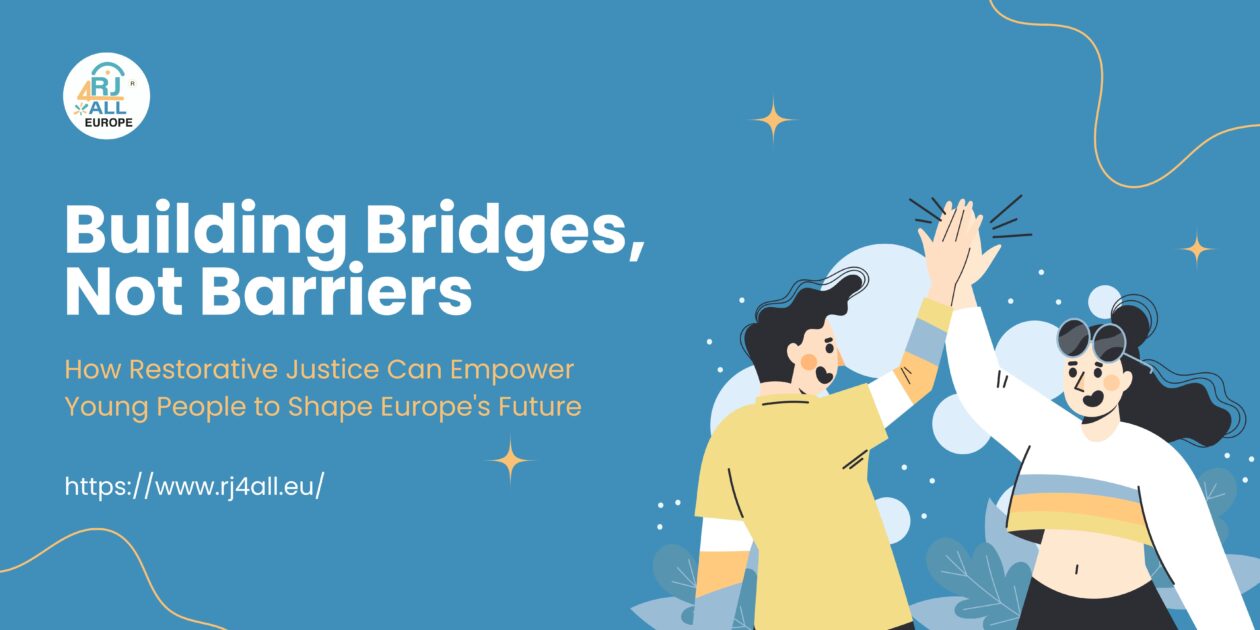
Youth participation, intercultural understanding and essential life skills through the values of power-sharing, equality, dignity and respect.
Young people have an essential role to play in shaping Europe’s future. However, meaningful participation requires more than giving them a voice. It means providing the confidence, skills and opportunities to influence decisions, challenge inequalities and contribute to their communities. This is where restorative justice can make a difference. Building relationships through restorative justice
Restorative justice is about more than resolving conflict. Its core values of power-sharing, equality, dignity and respect offer a framework for building stronger relationships and more inclusive communities. For young people, these values encourage open dialogue, active listening and mutual understanding. They create opportunities to challenge stereotypes, learn from different perspectives and approach disagreements constructively. By putting these principles into practice, young people can become active participants in creating positive change rather than simply recipients of decisions made by others.
Developing skills for active citizenship
To participate confidently in society, young people need essential skills that help them communicate, think critically and collaborate.
Three skills are particularly important:
- Critical thinking: Questioning assumptions, recognising misinformation and understanding different perspectives.
- Public speaking: Expressing ideas confidently, sharing experiences and advocating for issues that matter.
- Digital communication: Connecting across borders, communicating responsibly and using digital platforms to support positive change.
These skills are not only valuable for education and employment. They are essential tools for democratic participation and responsible citizenship.
Intercultural understanding: Learning from one another
Europe’s diversity is one of its greatest strengths, but meaningful inclusion requires dialogue and understanding. Restorative approaches encourage young people to listen without judgement, recognise different experiences and build connections across cultural and social differences. Through intercultural exchanges, young people can challenge stereotypes, develop empathy and discover shared values. They learn that disagreement does not have to lead to division and that different perspectives can strengthen communities.
Connecting young people through Building Bridges
The Building Bridges project brings these ideas into practice by combining restorative justice, digital learning and intercultural youth exchanges. Bringing together organisations from Europe and Africa, the project aims to engage 1,000 young people through accessible learning opportunities and virtual exchanges. Its multilingual eLearning programme, available in English, Romanian, Italian, Greek, Somali, Arabic and Swahili, supports young people in developing essential soft skills and exploring the European Youth Goals. Through facilitated virtual exchanges, participants can share experiences, develop intercultural understanding and build the confidence to become active changemakers. The project also supports youth workers in creating inclusive digital environments where young people can communicate, collaborate and learn together.
Shaping the future, together
Empowering young people means recognising that their experiences, ideas and perspectives matter. By combining restorative justice values with essential life skills and intercultural dialogue, we can create opportunities for young people to participate more confidently in society and contribute to a fairer, more inclusive Europe.
Building bridges is about more than connecting people across borders. It is about creating relationships based on trust, equality, dignity and respect. Building Bridges, Not Barriers. Together, we can make every voice count.
Enrol here: BB-enrollment-tutorial-UNITED.pdf