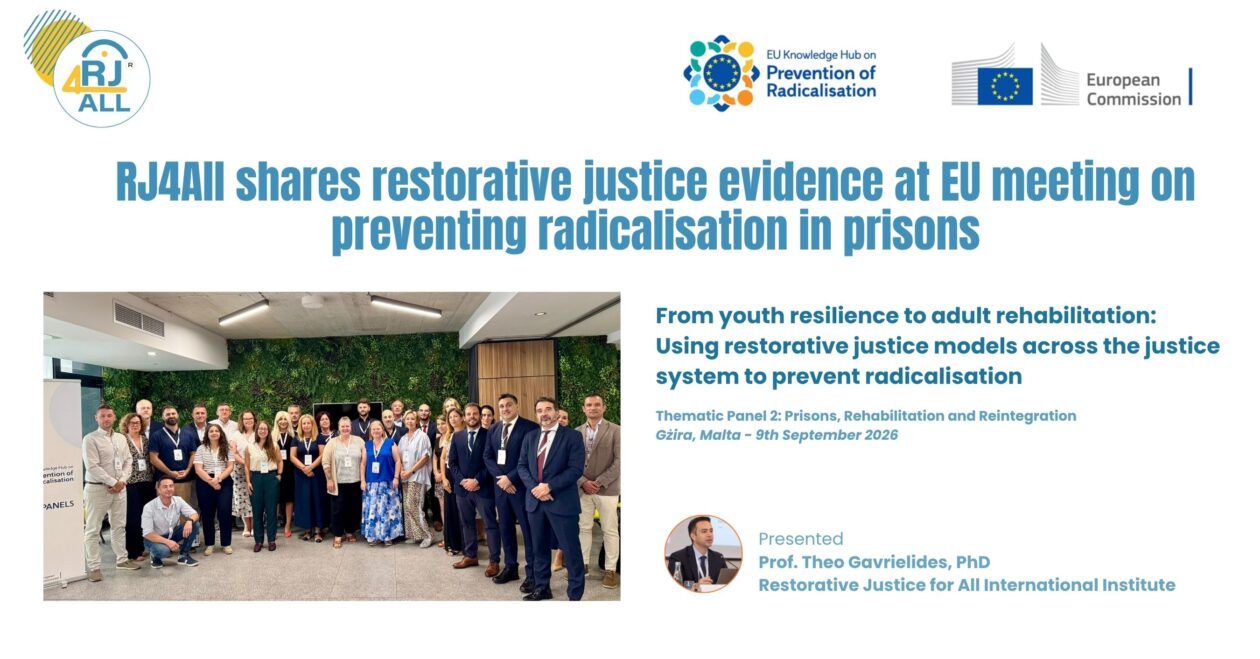
Professor Theo Gavrielides, founder and director of Restorative Justice for All International Institute, took part in the fifth meeting of Thematic Panel 2 on Prisons, Rehabilitation and Reintegration, held by the EU Knowledge Hub on Prevention of Radicalisation in Gżira, Malta, on 9 and 10 September 2026. The two-day meeting brought together policymakers, practitioners and researchers from across the EU to examine how prisons, probation and community services can prevent radicalisation among young people and support their rehabilitation and reintegration. Professor Gavrielides presented ‘From youth resilience to adult rehabilitation: Using restorative justice models across the justice system to prevent radicalisation’ supported by RJ4All’s Restorative Justice evidence and models to the panel.
Why prisons matter for radicalisation prevention
Correctional facilities remain conducive environments for radicalisation across Europe, and a growing number of radicalised individuals are being released from prison each year. Thematic Panel 2 was established to address this challenge, promoting a multi-agency approach to rehabilitation and reintegration and working towards a continuum of support from incarceration through to post-release, including harmonised risk assessment tools and stronger cooperation between prisons, probation services and community organisations.
Setting the evidence base
The meeting’s discussion paper, “From Vulnerability to Resilience: Addressing the Risks and Needs of Young People in Detention and Community Sentences”, set out the evidence base for the two-day discussion. It covered the developmental and psychosocial vulnerabilities of justice-involved youth, the particular risks of detention and community settings, and the clinical, correctional and community perspectives needed to respond to them.
RJ4All’s contribution
Within this context, Professor Gavrielides presented “From Youth Resilience to Adult Rehabilitation: Using Restorative Justice Models Across the Justice System to Prevent Radicalisation”. He set out RJ4All’s RJiNEAR model, a restorative justice and psychosocial approach to preventing violent radicalisation piloted across 12 European countries over eight years, with evidence of improved resilience, recidivism and victim and community satisfaction outcomes. He also shared findings from RJ4All’s ongoing pilot with the Youth Justice Board and Coram across ten youth justice services in England and Wales, which is testing restorative justice practice with young people in the justice system.
Building consensus through convening
By bringing this evidence into a European policy forum, RJ4All continued its role in convening practitioners and policymakers around a shared understanding of restorative justice. This is part of a wider vision held by RJ4All Europe, the Institute’s Europe wide but Cyprus-based organisation, which works to embed restorative approaches within EU policy and connect them to a growing global movement for restorative justice. For RJ4All, dialogue of this kind at EU level is not separate from grassroots practice in the UK and beyond, but part of the same effort to build consensus, one conversation at a time, on how societies respond to harm.
If you are interested in partnering with RJ4All on restorative justice-focused webinars and/or conferences, please contact Professor Theo Gavrielides at t.gavrielides@rj4all.org.